
We Fed Claude 10 Real McKinsey Decks and Asked It to Build a Pitch. Here's How It Did.
- 1 hour ago
- 10 min read
"Rest in peace McKinsey, I can show you how to do it all with AI." That kind of clickbait floods LinkedIn these days, and most of it is nonsense. The prompt libraries being sold for $49 don't get you anywhere close to McKinsey-level work.

But there's a kernel of truth in the noise. In May 2026, Business Insider reported that Blackstone, Anthropic, Hellman & Friedman, and Goldman Sachs are jointly building what's been called "the McKinsey of AI." Whether that lands or not, the question of how close the current generation of AI gets to actual McKinsey work is worth answering — not with vibes, but with a real test.
We spent 6+ years each at McKinsey, we built decks for senior client meetings, and we've reviewed thousands of pitch slides as consultants and as managers in our corporate roles since. So we decided to run a clean experiment. We gave Anthropic's Claude 10 real McKinsey decks to learn from. Then we asked it to build a pitch deck of its own. Then we scored it like we'd score the deck of an associate fresh off training.
If you want to see the detailed video analyzing every aspect, check out our YouTube video:
Here's what we found.
The Setup
Three steps:
1. Teach Claude what a McKinsey deck looks like. We fed it ten real Letters of Proposals (in short LOPs). LOPs are the pitch decks McKinsey uses to answer a client's request for proposal (in short RFP - consultants love abbreviations), trying to win the the consulting project. Based on these McKinsey slide decks we asked Claude to extract a styleguide. We picked LoPs specifically because they're the visually highest-quality work product the firm produces. If Claude can't match an LoP, it can't match anything more demanding.
2. Give Claude a real consulting task. The prompt we used:
Please create a presentation pitching the advantages of renewable energy. We operate a sustainability fund and our audience is institutional investors. We want to convince them that they should invest into renewable energy via our fund.
We picked this broad topic for several reasons: It is broad enough that there's plenty of public data to work with, but specific enough that you have to separate the important from the unimportant.
We ran the test twice: once on Claude itself, once on Claude Design. The outputs were nearly identical in substance and quality.
3. Score the result like a McKinsey partners would. We rated the deck on five dimensions, each scored on a 5-point scale:
Structure
Storyline
Writing style
Content
Visual design
Alright, so lets get right into the headline numbers:
Dimension | Score |
Structure | 3 / 5 |
Storyline | 2 / 5 |
Writing style | 4 / 5 |
Content | 2 / 5 |
Visual design | 1 / 5 |
Total | 12 / 25 |
Now the detail.
1. Structure — 3 / 5
The first thing drilled into the head of every McKinsey consultant is "be structured." So this is where we started.
Claude got the high-level structure right. Four clean chapters, each clearly labelled, with the table of contents reused as section dividers later in the deck. That part worked.

It also tried to do something McKinsey loves — using trackers in the headers (the little a/b/c or I/II/III labels that show where you are in the document's logic). Good instinct. The execution was sloppy. On one slide suddenly an a/b/c tracker is introducted that's never picked up again. On another slides, Roman numerals I/II/III appear but are never picked up again. And on the next slide, another tracker switching to Arabic numerals 1/2/3/4 with no logical link to the previous slide in introduced. You get the message: A reader trying to follow the thread would assume the trackers mean something and get confused when they don't.

The other miss: Claude opened with a table of contents. A real McKinsey deck for a senior client audience opens with an executive summary: a single slide that lands the whole pitch in 60 seconds. The ToC is a school-essay move. The executive summary is the consultant move.
The fundamentals were there. The execution wasn't yet at the level we'd accept from a McKinsey consultants.
2. Storyline — 2 / 5
The high-level storyline is good. The four chapters are exactly how we'd structure a fund pitch: explain the market dynamics, lay out the investment thesis, pitch your fund's specific advantages, close with next steps. Sound logic.
But once you go one layer deeper, things fall apart fast.
The biggest problem: the deck isn't MECE. Topics from chapter 1 reappear in chapter 2, sometimes verbatim. Policy drivers are introduced in the market section, then re-introduced in the investment thesis. The megatrends in chapter 2 should have lived in chapter 1, because the framing throughout the rest of the deck is "big picture first, then drill down". Putting megatrends in the investment section breaks that flow. The investment thesis itself feels like a mixed bag: IRR (which belongs) sits next to megatrends and policy (which should be in the market section).

A second pattern: the action titles often don't quite link to what's on the slide. Action titles are the headlines at the top of each slide. They're supposed to land the slide's takeaway in one sentence. If you flip through the deck reading only the action titles, you should walk away with the full story. Claude's action titles read well on their own, but on multiple slides the supporting content doesn't substantiate the claim. The most striking example: a slide claiming "renewables are now the cheapest energy source in 90% of countries" — except there's nothing on the slide that backs the 90% number. You can argue renewables are cheaper than fossil fuels in some sense, but the only claim the slide actually supports is that renewables got cheaper between 2015 and 2024. The headline overstates what the data shows.

Storyline is where a great consultant earns their salary. Claude isn't earning that salary yet.
3. Writing Style — 4 / 5
This was Claude's strongest dimension. The writing is sharp, consistent, action-oriented, and free of obvious filler. Bullets are well-formulated. Take-away boxes are punchy. Action titles read like real McKinsey action titles, even when they're overstating the slide's evidence.
One pattern dragged the score down: the chapter-description writing is too vague. On the opening overview slide, Claude wrote things like "the renewable market is at an inflection point." That's the kind of phrase a McKinsey partner would strike out with a red pen on first read. What does "inflection point" mean? Sharp upward move? Sharp downward move? The reader is left guessing.

The rule we drill into juniors is: don't leave the audience guessing. Lead with the main message. The first chapter's overview should say "the renewables market is growing". Straight and to the point. The wording can get more sophisticated and specific, but the underlying claim has to land on the first read. This isn't a novel where the reader has to wait until chapter four to find out what happened. The reader has to know what you're claiming on page one.
A second smaller miss: action titles could pick up a specific data point from the chart underneath. "Growing ESG mandates and regulatory requirements are creating structural demand for renewable energy exposure" reads fine. "ESG mandates and regulatory requirements are pushing ESG-mandated AUM past $50T by 2026" reads better. The data point makes the claim concrete and harder to argue with.
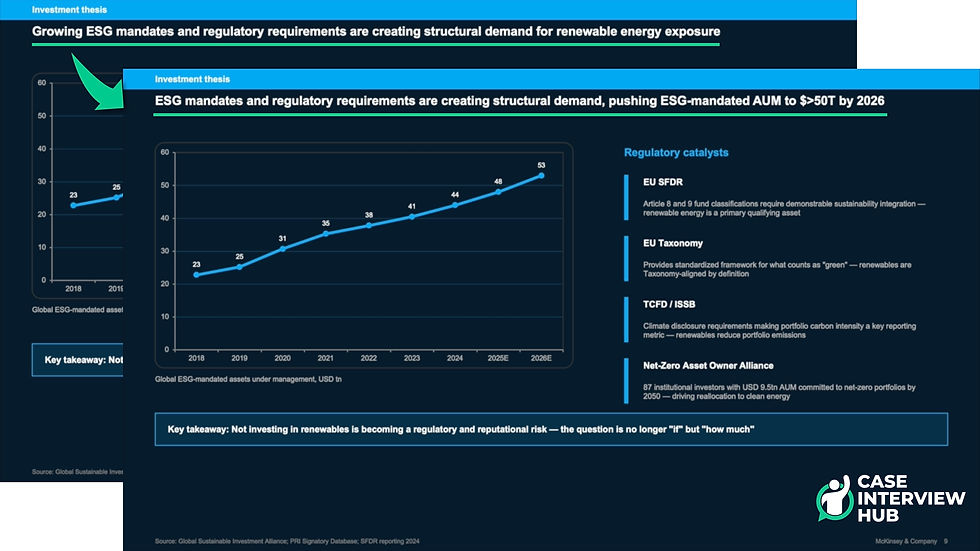
But these are edits a senior would make to an already-good draft. The underlying writing quality is genuinely there.
4. Content — 2 / 5
This is where we expected Claude to do best. Surely the LLM that's read the entire internet would nail the content. The result was mixed.
The source selection is strong: McKinsey Global Energy Perspectives, BloombergNEF, Lazard, IEA, IRENA, EU Commission, US Department of Energy. Exactly the sources we'd reach for ourselves. Top marks.

The source usage is shaky. Claude cited a figure of "$620 billion invested in renewables in 2025." BNEF's actual figure for 2025 was closer to $690 billion. The IEA puts it at $780 billion. Neither number is what Claude used. If an associate brought us a slide with a wrong headline figure in a pitch to institutional investors, that's an immediate red flag — you don't get to be off by $70-160 billion in a pitch. If Investors check the number you are screwed because you will lose all credibility instantly.

The content logic also slipped in places. The deck conflates ESG with climate. They're related but they're not the same thing. ESG mandates can drive demand for renewables, but they can also drive demand for things that have nothing to do with climate (governance, social standards). The story Claude is trying to tell is climate-driven. So the chart on the slide should be a climate-specific data point. For example the green bond market or an analysis of the use of proceeds from those bonds. Instead Claude used a generic ESG-mandated AUM chart, which doesn't quite prove what the surrounding text claims.

And then there's the harder question: can Claude do serious analytical work? Can it combine data sources, transform a dataset, build a model from sample company data and extrapolate it to the overall market? That's the kind of analysis that it at the center of a McKinsey deck, and Claude didn't attempt anything like it. We'd give it the benefit of the doubt. With proper data integration this might work better. But right now, what Claude did was research and summary, not analysis.
5. Visual Design — 1 / 5
Let's be honest. Claude does not come close to the visual quality of the McKinsey decks we fed it. The colour scheme is roughly right. The overall feel is there. But the execution would fail a partner review.
The recurring pattern is slides that feel empty. The charts are too small. The font sizes are mixed. Headers on charts are missing on multiple slides. Action titles are formatted in Arial when McKinsey would use Georgia.

A few specific examples (the ones that would get circled with red ink in a real review):
Inconsistent colour-coding. On the slide comparing renewables to other asset classes, "strong" returns are coded green for renewables but a different colour for infrastructure. "Low" risk is coded one way for renewables and another way for investment-grade bonds. The reader can't trust the colour signalling.

Trackers that mean nothing. Same problem as the structure issue, but here it shows up visually. The reader's eye sees structure being signalled, then can't decode what the signal means.

Empty slides. Multiple slides could have been salvaged by stretching the chart to fill the canvas, bumping the font size, and spacing the text out properly. Claude consistently produced slides that look like a consultant ran out of time, handing in a work in progress slide.

A few things Claude did right are worth flagging too. It stayed within the layout boundaries the action titles set up. That's a real win, because most AI tools wander outside the canvas constantly. The colour palette is close to McKinsey's actual palette. And the "large numbers, small explanatory text" treatment Claude used on a few slides is genuinely McKinsey-style even though the font choice is wrong.
But "got the colours right" isn't enough to clear the bar. A junior consultant who delivered this work would be on a performance improvement plan the next week.
The Verdict: Can Claude Replace McKinsey?
The short answer: No.
The deck Claude produced is, by McKinsey standards, junior or intern level on its best dimension and outright unacceptable on its weakest. The total score (12 out of 25) is what we'd give a strong intern's first attempt, not a deliverable for institutional investors.
But the more honest verdict is the following: Claude didn't fail because it's a useless tool. It failed because the bar for the deliverable is genuinely high. The gap between "passable slideshow" and "deliverable for a senior client meeting" is much wider than most people think.
The more useful question:
Where is Claude actually useful in the consulting workflow today?
Where Claude Actually Helps
Reading through Claude's output, three things stood out as legitimately valuable:
1. Getting started. A blank canvas is the hardest part of any deck. Claude's first draft, with its four chapters and rough storyline, gets you past the empty page in five minutes. Even with the structural problems, the starting point is better than what most consultants produce on their own in the first hour.
2. Research and source surfacing. Claude correctly identified the right sources for a renewables pitch. BNEF, IEA, IRENA, Lazard, and the right McKinsey perspectives. A junior consultant would have had to spend half a day to identify the same set. The numbers it pulled from those sources need checking, but the sources themselves were spot-on.
3. Action-title writing. Even when the action titles overclaimed against the underlying evidence, they were genuinely well-written. A consultant editing a Claude draft would keep most of those titles and adjust the supporting bullets, rather than rewriting from scratch.
What Claude can't do, or at least not yet, is the senior consultant judgement. MECE structure. Calibrated claims that match the evidence. The visual polish that signals "we take this client meeting seriously." The analytical work that turns research into insight. Those are still the consultant's job.
The Bottom Line
The "AI is going to replace consultants" framing makes for great LinkedIn engagement and bad reasoning. The honest picture in mid-2026 is more interesting: AI can do the lower-leverage parts of a consulting deck (research, source screening draft structure, action-title writing) at a quality level that already saves real time. It cannot yet do the senior consultant work (MECE structure, calibrated claims, visual judgement and storytelling, real analysis) at a level that holds up in front of a senior client audience.
The implication for anyone aiming at consulting today: AI changes the approach to certain tasks and speeds up the work. The work that used to be "junior consultant creates the dummy deck" is increasingly something AI handles, which means the work that humans are paid for skews even more toward the senior consultant tasks. Which makes the core consulting skills (i.e., structured-thinking, storytelling, linking analysis to valuable implications for the client) even more important, not less.
If you're aiming for one of those consulting jobs, the case interview is still the gate. Our Case Interview Mastery course on Udemy gives you 7 McKinsey-style cases with detailed model solutions and interviewer feedback, taught by us, two former McKinsey interviewers. The structuring, analysis, and synthesis skills the course drills are exactly the things Claude couldn't do well in this experiment.


Comments