
The Real Cost of a McKinsey Consulting Project
- Apr 24
- 7 min read
Updated: Aug 25
McKinsey, BCG, and Bain are the kingpins of strategy consulting — but they're also notoriously expensive. Collectively, they make billions per year from projects. But how much does it actually cost to hire them?
We spent 6+ years each at McKinsey. We've written project proposals with fee structures attached. We've seen what clients pay, how the math works, and why the numbers are what they are. In this post, we'll break down the three fee models consulting firms use, walk you through actual per-diem rates, and show you what a typical MBB project costs from start to finish.

The Three Fee Models
Before we talk numbers, let's discuss how consulting firms actually make money. There are broadly three compensation models.
1. Time-and-Material (the most common)
This is the standard model. Consultants are paid based on how much time it takes to complete the project — but it's not like a taxi meter that just keeps climbing. The partners, together with the client, scope out the project ahead of time and agree on a timeline and team structure. That determines the fees. So the client knows exactly what it's going to cost before the project starts.
A typical setup looks like this: we need 8 weeks, with 2 Associates and one project manager. That's 80 Associate-days and 40 project manager-days, each billed at their respective daily rate. Add roughly 10 days of partner support at a higher rate, and you get the total project price.
The advantage for the client is predictability — you know what you're getting and what it costs. The disadvantage is that the consultant isn't incentivized to go way overboard and deliver extra. Of course, most consulting firms will be accommodating to a degree, because they want to keep the client happy and maintain a long-term relationship. But if the scope creeps too far, the client and consultant will need to agree on an extension — say, adding 4 more weeks to the engagement.
2. Performance-Based Fees
Here the consulting fee is variable, based on the outcome of the project. The more successful the project, the higher the fees. This model is less common because it doesn't suit all project types — it's tough to objectively measure the long-term success of a strategy project. It works best for engagements where success can be clearly determined through measurable KPIs, usually in longer-term programs of 6 months or more.
The classic example is a cost-cutting program. The consultant gets a percentage of the savings identified — say, 5%. Reaching $100 million in savings means $5 million in fees. Reaching $50 million means $2.5 million. Reaching $150 million means $7.5 million.
More complex structures are common too. You might agree on a base fee of $1 million, and then for everything exceeding $50 million the consulting firm gets a 10% slice. If the project only reaches $50 million, the client pays $1 million. If it reaches $100 million, it's $1 million base plus $5 million success fee — $6 million total.
The advantage is clear: the incentives of client and consultant are more aligned. If you just pay the firm based on time spent, they won't care much whether savings land at $50 million or $150 million — their payout is the same. With performance-based fees, it's in the consultant's interest to push for more impact.

The disadvantage is moral hazard. A consultant does have an incentive to make an idea seem better than it is, or to suggest ideas that are ultimately detrimental to the organization. We've seen fierce discussions between consulting teams and client finance teams who don't believe in the savings potential of an idea. "You forgot A, B, and C in your calculation," they'll say. "You overestimate X, Y, and Z." Then you really have to fine-tune the business case and get everyone's buy-in.
Or a consultant might suggest reducing certain safety measures. That sounds terrible, but it's not uncommon for a company to exceed not just the legal requirements but also the highest industry safety standards — often without evidence that the gold-plating actually increases safety. Suggesting to reduce the gold-plating is usually met with resistance from the operations or health & safety teams. And while we're not going to sugarcoat that there are individual bad apples in virtually any consulting firm who'd push too hard, the fact that ideas are pressure-tested from all angles generally leads to solid outcomes.
The key nuance: performance-based fees create more alignment between client and consultant incentives — but not exact alignment. A client wants feasible ideas that lead to sustainable savings while maintaining operational performance. A consultant, in this model, primarily looks for formal recognition of savings by the client stakeholders. Those are related but not identical objectives.
3. Equity Partnership
The consultant literally gets part of the company. This is rare but worth knowing about. The most common use case is when a consulting firm helps a client build a corporate venture — almost like a startup from scratch — or a spin-off where part of the company is carved out. The consultant receives a percentage of equity in the new entity.
The advantage is that incentives are fully aligned: everyone wants to build a sustainable long-term business. The client doesn't need to pay out cash, and the consultant has theoretically unlimited upside. The downside is that it only works in a limited number of cases and is extremely complex to structure. Most of the time, you just want a check.
Bain historically puts a bit more emphasis on performance-based and equity models than McKinsey or BCG, but the time-and-material model still dominates across all three firms.
The Actual Numbers: What MBB Charges Per Day
Now let's get into the numbers. We'll focus on the time-based model since it's by far the most common.
First, an important caveat: there isn't one number. Fees depend on the consulting firm (McKinsey usually represents the upper end), the location (not every market commands US rates), the sector (PE projects are charged more; government projects often have caps), and whether any discounts apply (first project with a new client, long-standing relationship with a master service agreement, etc.).
That said, here's a realistic ballpark based on what we've seen on private-sector McKinsey project proposals:
Associate: ~$6,000 per day
Project Manager / Engagement Manager: ~$8,000 per day
Partner level: easily above $10,000 per day — but partners are not on board full-time. They might book 1–2 days per week each. On a typical project you'll have multiple partners involved at different levels (junior partner, partner, senior partner), collectively booking around 5 days per week.
One thing about these per-diems: don't get hung up on the individual numbers. An Associate may not be "worth" $6,000 per day, but there's a lot of cross-subsidizing going on. These rates have to cover partner salaries, the substantial back-office (researchers, designers, data scientists), and all the non-revenue-generating time — when consultants aren't staffed on a project but still get paid, plus sick leave, trainings, and other benefits.

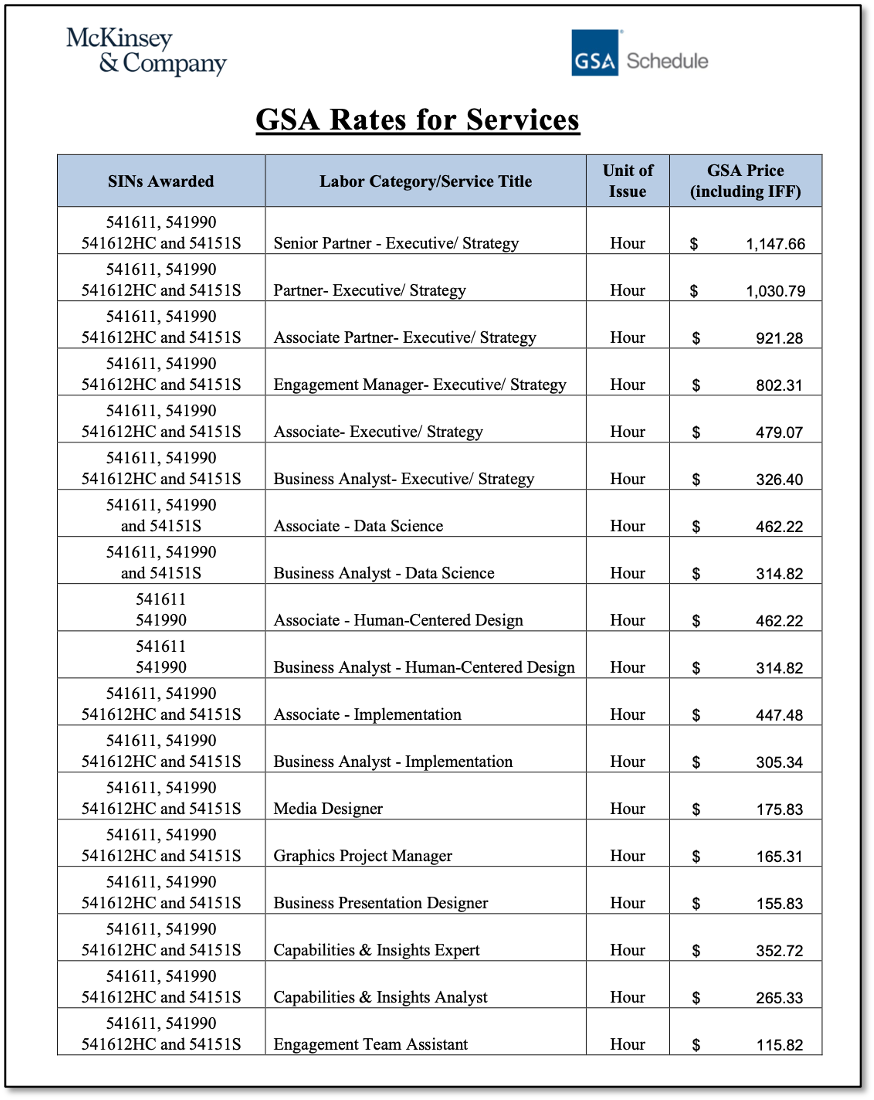
For comparison, the US government publishes consulting rates through a service called GSA Advantage. McKinsey's listed hourly rates there show partners above $1,000/hour, project managers at ~$800/hour, and Associates at ~$460/hour. Those appear to be on the lower end compared to private-sector rates — likely because government clients negotiate harder or the rates imply longer working days.
What a Typical Project Actually Costs
Let's put it together. A typical mid-sized McKinsey project with 1 Engagement Manager, 2 Associates, and adequate partner-level support runs into the $150,000 per week range. That's before taxes, and before any additional expenses like third-party data purchases — but also before any discounts.
So an 8-week project with this team structure comes with a price tag of roughly $1.2 million.
Want a larger team? Add a third Associate, and the weekly rate jumps to around $180,000 — or $1.44 million for 8 weeks.
These are realistic figures. In the US, they can be even higher. In southern European markets, they're lower. We've seen numbers like these many times on project proposals we wrote for mid-sized McKinsey projects.
How Do BCG and Bain Compare?
BCG and Bain also command relatively high fees, but they can be meaningfully cheaper than McKinsey depending on the situation. In competitive pitch situations, we've seen them offer projects for roughly half the McKinsey price. But usually the gap isn't that wide.
Second-tier firms (Kearney, Strategy&, Oliver Wyman) are less expensive still. And more local firms or Big 4 advisory practices can be significantly lower.
Comparisons get sketchy at a certain point, because headline per-diems become meaningless when a firm heavily discounts them. We've seen McKinsey lose projects to reputable lower-tier firms that offered the work at one-third of the McKinsey price. And sometimes clients reduce the scope of a project and hand it to a lower-tier firm to save money. That's a legitimate strategy — not every project needs McKinsey.
The Bottom Line
Consultants are expensive. A single MBB project can easily cost $1–2 million, and large-scale global transformation programs run into eight figures. Whether that's worth it depends entirely on what the client gets in return — and the firms wouldn't have been successful for decades without delivering.
If you're on the other side of this equation — the aspiring consultant trying to land one of these roles — the interview is your barrier to entry. Our Case Interview Mastery course on Udemy walks you through 7 full McKinsey-style cases with detailed solutions, taught by us, two former McKinsey interviewers. . And our CV Masterclass covers everything you need to build a CV that gets past MBB screening.
Related posts you might find useful:
Related video: Watch our YouTube video: The REAL Cost of a McKinsey Consulting Project:


