
A Day in the Life of a Consultant at McKinsey, BCG & Bain
Updated: Aug 25
How can a 22-year-old advise seasoned corporate executives on matters of strategy, cost cutting, mergers, and restructurings? Are Fortune 500 companies actually paying millions to consulting firms that send fresh college grads to dish out advice? What do they actually do all day?
These are the questions we get most from people curious about consulting. And they're fair questions. We spent 6+ years each at McKinsey, and in this post we'll walk you through what daily life actually looks like for a consultant — from the team setup to the weekly rhythm to the responsibilities outside of projects.

The Team: Nobody Shows Up Alone
Right off the bat, it's important to understand that consulting is a team sport. A young consultant will never show up alone at the doorstep of a client and start advising. He or she is always part of a team. Let's look at a typical project team, because this is the context in which everything else makes sense.
The analysts. At the lower levels you'll find business analysts — that's at least what McKinsey calls them, but every firm uses different names. There's a distinction between junior and senior consultants, referring to those fresh out of undergrad and those with some experience or an MBA. But regardless of seniority, their role on projects can be summarized as doing the bulk of the legwork. They interview clients to gather information, analyze data, and build PowerPoint presentations.
The project manager. The middle layer. Again, different names at different firms — engagement manager, case team leader — but the job is the same: coordinate the project operationally. They've spent a couple of years as analysts themselves, and now they give guidance to junior colleagues. Project managers are also the link to the partner level. They receive direction from partners, leverage them for high-level issues, and serve as the face of the team for most clients since they're the highest-ranking consultant on the project full time. They keep the plates spinning. And yes, they're stressed out a lot.
The partners. On top, you have the partner level. Firms may distinguish between junior partners, partners, and senior partners, but what they have in common is that they're not fully focused on one project. They coordinate multiple teams, secure new projects through proposals and pitches, and serve as the intellectual backbone of the firm. With years of experience, they're often respected industry experts. They're the valued sparring partners to the board and talk directly to the CEO. Meanwhile, the operational project team handles the day-to-day work with lower-level clients.
Beyond this standard setup, projects today are getting more diverse and complex. Increasingly, the team is complemented by specialists at all levels — a data scientist helping the team, an industry expert explaining the latest market dynamics, or an executive coach running a leadership session with the CEO. It can be quite a rag-tag team of people, but it gets the job done.

The Weekly Rhythm: Everything Revolves Around the SteerCo
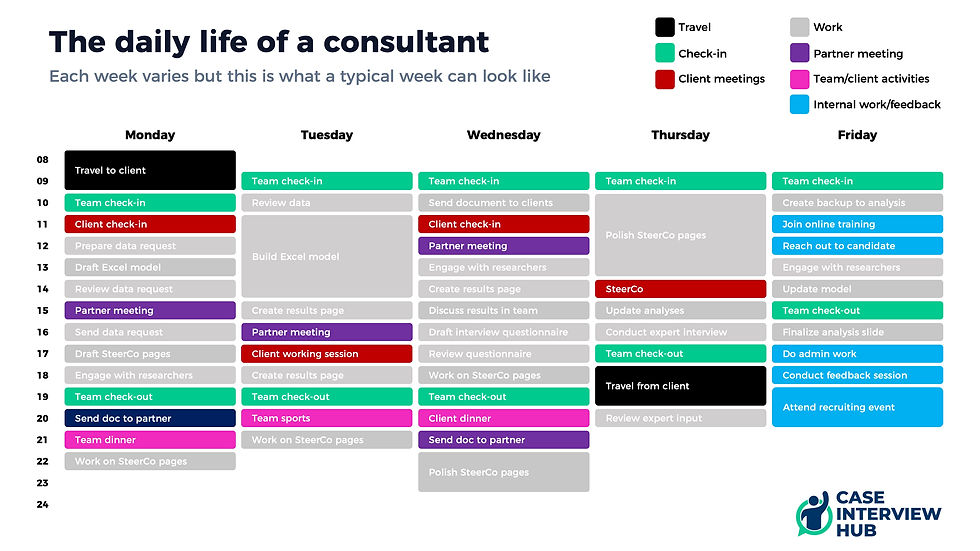
It's actually hard to describe a "typical day" in consulting because the work varies so much. A typical week makes a lot more sense, because the week has a structure that repeats.
A week in consulting often revolves around one key client meeting — the weekly Steering Committee, or "SteerCo." In this meeting, the consulting team and key clients review the project's progress, discuss insights, and align on next steps. This meeting is prepared by the consultants, and a lot of effort goes into making it a success. That means showing good progress on all workstreams of the project and packaging it into a compelling storyline.
The team will meet with the partner at least twice during the week to discuss progress, get the partner's expert input on specific workstreams, and receive guidance on how to polish the document. And of course, clients are involved in the process too — there'll be check-ins and working sessions throughout the week.
What a Day Actually Looks Like
On an operational level, days typically start with a check-in. The project manager discusses the priorities for the day with the analysts: what analyses need to be done by tonight, which client meetings are on the agenda, what needs to be prepared for them, what do we want to get out of them. And if there's a partner session that day — what are we going to ask them, and where do we need help or input?
Then the analysts disperse and work on their individual workstreams. This could involve all sorts of things:
Reaching out to a client contact for data
Building an Excel model with that data
Putting the findings of an analysis on a PowerPoint slide
Engaging with researchers in the back office for further insights
Preparing and conducting interviews with industry experts
The project manager acts as the sparring partner throughout the day — helping prioritize issues, giving feedback on analyses or slides, and joining important client meetings, especially when the client is senior and the analyst is still quite junior.
And of course, there's lots of internal discussion to solve problems and create a polished SteerCo document.
Based on all of this, you might think consultants don't eat. But don't worry — we squeeze in a lunch somewhere.
In the evenings, there's typically a check-out to discuss what's still open before calling it a day. If all goes well, there may be a dinner with the team, sometimes with the partner, and occasionally even with clients. Or the team might do sports together. If it's a stressful phase of the project, though, teams work late — sometimes past midnight. Then it's no fancy dinner, but a pizza will do just fine.
The Travel Rhythm
In a typical week, the operational team would fly in and arrive at the client site on Monday morning, and leave on Thursday evening. That's the classic model that consulting has been built on for decades.
COVID changed a lot here. Firms and clients have gotten much more flexible. The old Monday-to-Thursday model still exists, but depending on the project, there are now hybrid and even fully remote setups. You might spend one week at the client site, one week in the home office, and a few days at the firm's local office in between. The flexibility varies by project and by client, but the days of mandatory Monday morning flights and Thursday evening red-eyes every single week are largely behind us.
What Happens Outside of Projects
Outside of direct project work, there are plenty of other things that analysts do. A lot of this happens on Fridays, when consultants often work from their home offices.
On the one hand, there's admin work related to the ongoing project — doing expenses, booking travel for upcoming weeks. On the other hand, there's the feedback and development side. Getting and giving feedback is a big part of a consultant's life, and Fridays are often when those conversations happen. It's also a good day to do short trainings.
Junior consultants are often involved in office activities too — organizing an event, joining a company initiative, or doing recruiting work like talking to students at their alma mater. Those with at least 2 years of experience may even be interviewing candidates themselves. So there's quite a bit going on outside of projects, even though the project work alone is already pretty demanding.
So Are 22-Year-Olds Really Advising CEOs?
Hopefully by now we've debunked the idea that a kid is waltzing into the CEO's office and explaining the world to him. Junior consultants are not advising CEOs solo. They're working within a team structure where partners handle the senior client relationships and project managers coordinate the operational delivery. The analyst's job is to do the analytical heavy lifting — build the models, crunch the data, interview the right people, and put findings into a format that the senior team can use to advise the client.
That said, it's still a fast-paced and exciting job with an incredibly steep learning curve. Within your first year, you'll learn to manage yourself under pressure, create presentations and Excel models, handle difficult clients, and work effectively in a team. Whether you stay in consulting for 3 years or 10, those skills will serve you for the rest of your career.
The Bottom Line
A day in the life of an MBB consultant is structured around the weekly SteerCo rhythm, filled with data analysis, client interaction, team discussions, and — yes — a lot of PowerPoint. The hours are long, the learning is intense, and the variety is unmatched. One week you're analyzing a bank's digital strategy in London, the next you're helping a retailer cut costs in Chicago.
If this sounds like the kind of career you want, the first step is getting through the interview. Our Case Interview Mastery course on Udemy walks you through 7 full McKinsey-style cases with detailed solutions — taught by us, two former McKinsey interviewers. And if you need help with your application before the interview stage, our CV Masterclass covers everything from a blank page to a CV that gets past MBB screening.
Related posts you might find useful:
Related video: Watch our YouTube video: A Day in the Life of a Consultant at McKinsey, BCG & Bain:


