
M&A Case Interviews: The Complete Guide (2026)
M&A is the case that scares people. Two companies, valuation multiples, talk of synergies, and a nagging worry that you needed an investment-banking internship to solve the case.
So let us kill that worry first. Do you need to be a finance major, or build a perfect valuation model to ace an M&A case? No. We spent 6+ years each at McKinsey, first as consultants and later as interviewers, and we can tell you that an M&A case is easily solvable if you can structure your thinking and solve basis arithmetic. What the case is actually testing is your judgment on three questions: is the target a good business on its own, does buying it create value once you subtract the cost and risk of combining the two companies, and is the price right. Get those right and you will ace the M&A case without touching a discounted cash flow (DCF) model.
This guide covers the framework, the synergy and valuation logic in plain terms, and shows a full worked example.

What an M&A Case Actually Asks
An M&A case asks whether one company should buy another. It comes in two flavours, and they shift where you spend the majority of your time on:
A corporate acquirer. One company buys another to grow, gain a capability, or capture synergies. Here strategic fit and synergies matter most.
A private equity buyer. An investor buys a company to improve it and sell it later at a profit. Here the financial return and the exit matter the most.
Two quick definitions so the vocabulary never trips you up. A merger combines two companies of roughly equal size into one. An acquisition is one company buying control of another. For a case interview, you solve both the same way. But if you have a nitpicking interviewer, knowing the definitions helps.
One more thing worth knowing: M&A often hides inside another case. A growth case can end with "so should they build this capability, partner for it, or buy a competitor?" The moment the answer is "buy," you are in an M&A case, even if nobody used the word.
Start With the Rationale: Why Buy at All
Before you structure anything, work out why the client wants to do this deal, because the reason decides what your analysis should focus on.
Companies buy for a handful of reasons: to grow faster than they could on their own, to acquire a capability or technology that would take years to build, to capture cost or revenue synergies, to consolidate a fragmented market, or to integrate vertically up or down their supply chain.
If the prompt does not tell you the reason, ask. "Acquiring for a financial return" and "acquiring to buy a technology we lack" lead to two different cases.
The Framework: Three Questions, Not a Template
Every M&A framework you will see covers the same areas. We find it cleanest to run them as three questions, with risk sitting across all of them:
Is the target a good business on its own?
Its market (size, growth, profitability, competition) and the company itself (revenue growth, margins, market presence, product, and any real moat). This is the due-diligence view: would you want to own this even before synergies?
Does combining the two create value?
The synergies, revenue and cost, minus the one-time cost and the risk of putting the companies together.
Is the price right?
The valuation, the payback, and the maximum you would pay before walking away.

As always, the buckets are where you start, not where you win. Reciting "market, company, synergies, financials" with no case-specific detail is the fastest way to sound like every other candidate. Tailor every branch to this buyer and this target to pass the case interview.
The Synergy Core: The Number That Decides It
Synergies are usually what makes or breaks an M&A case, so you have to put a number on them, not wave at "operational efficiencies."
Split them in two:
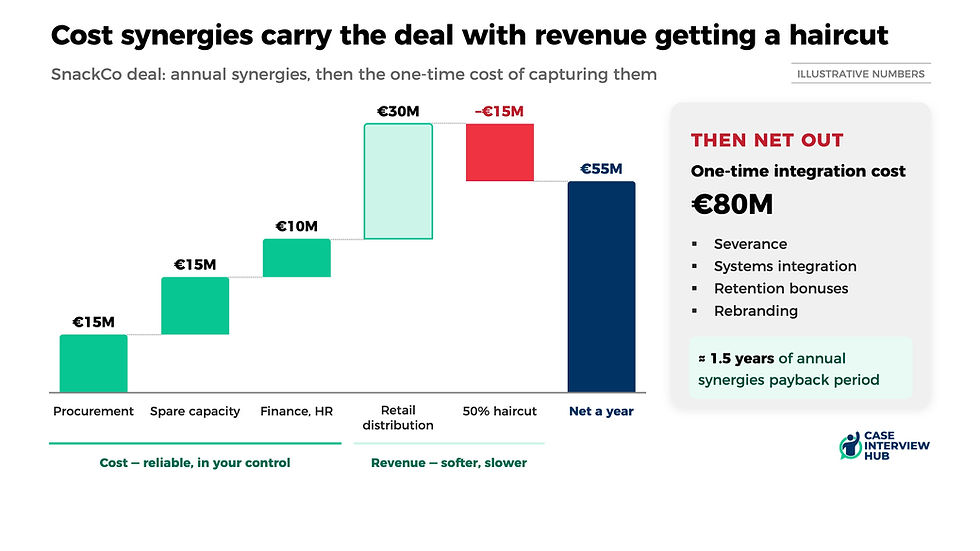
Cost synergies come from removing duplication: combining back-office functions, consolidating facilities, and buying inputs more cheaply at larger scale. They are the bigger and more reliable share of the value, because the buyer controls them directly.
Revenue synergies come from selling more: cross-selling to each other's customers, using one company's distribution for the other's products, or gaining pricing power. They are real but softer and slower, so apply a haircut and say why.
Then subtract the part everyone forgets. Capturing synergies costs money up front: severance, systems integration, retention bonuses, rebranding. A useful rule of thumb is that one-time integration costs run roughly one to two years of the annual synergies. But this is of course only a rule of thumb and heavily depends on the specific case. Net synergy, not gross, is what counts.
State your assumptions out loud as you go. "Combined procurement is about 200 million, I will assume a 10% percent saving at scale" is exactly the kind of structured estimate interviewers want, and it is the logic that is applicable to market sizing question.
Valuation Without a Model
Here is where candidates think they need finance training. They do not. You will never build a full DCF model in 30 minutes. And the valuation question is only a small part of the overall case. You need to understand three valuation concepts/ideas well enough to talk about them:
Comparable companies. What similar businesses are worth, usually as a multiple of profits (enterprise value to EBITDA). Apply the typical multiple to the target's profits for a rough value. This is known as CCA (i.e., comparable company analysis) or simply “Multiples”.
Previous transactions. What buyers actually paid for similar companies recently. These prices include a control premium. That is the extra a buyer pays to take over. This type of analysis is known as CCT (i.e., comparable transaction analysis).
Discounted cash flow (DCF), as a concept only. A business is worth the value today of the cash it will generate in the future. You describe the logic, you do not compute it. An important driver of the DCF valuation is the terminal value. The terminal value is the estimated value of the company after the detailed forecasting period. This value can account for >50% of the total value. So the DCF model is very sensitive to this assumption.
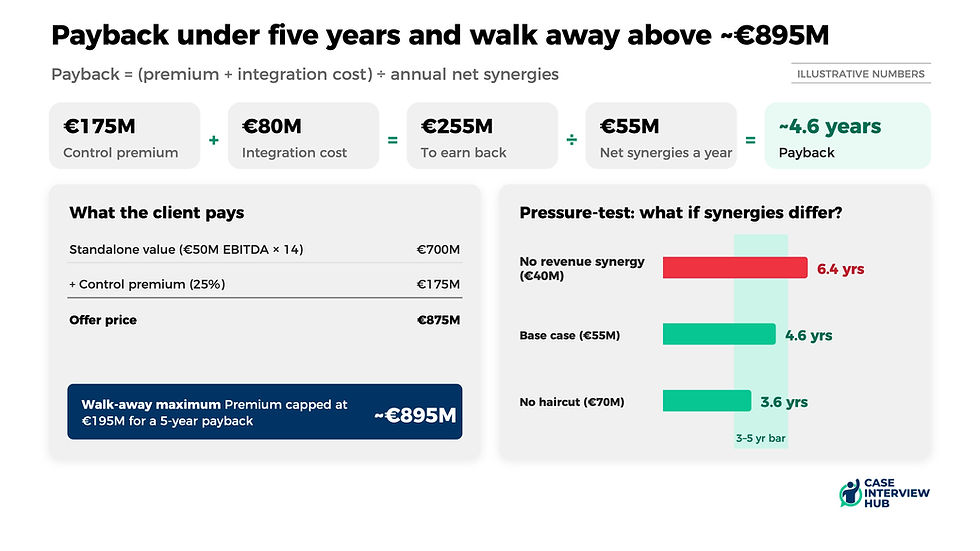
Then use the one number interviewers love: payback period. Take the premium you are paying plus the integration cost, divide by the annual net synergies, and you get the years to earn the deal back. Under roughly three to five years is generally fine, and beyond that the deal needs a strategic reason, not just a financial one. Finish by naming a maximum price. This will show the interviewer that you are thinking one step ahead.
Build, Buy, or Partner
Before you recommend buying anything, show that you considered the cheaper routes.
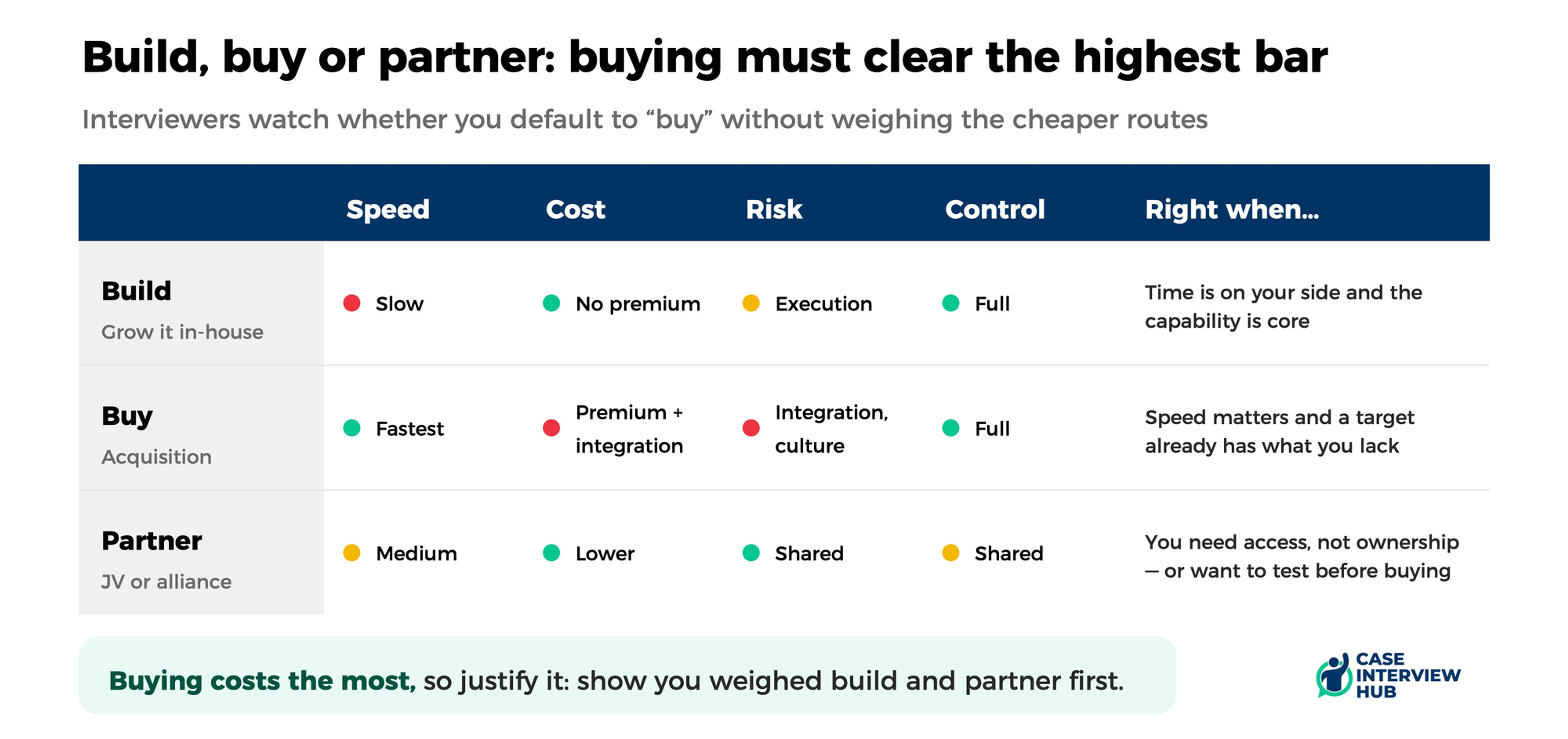
A company can build the capability itself (slow, but full control and no acquisition premium), partner through a joint venture or alliance (faster, shared risk, shared control), or buy (fastest, but the most expensive and the riskiest to integrate). Acquisition has to clear a higher bar precisely because it costs the most. Interviewers deliberately watch whether you default to "buy" without weighing the alternatives.
On a practical note: in the corporate world it often happens that senior managers shout “M&A!” without considering the simpler more cost efficient options. Highlighting to the interviewer whether M&A is really the only way to go shows that you are taking a holistic picture.
Worked Example: A Food Giant Buying a Healthy-Snack Brand
Let us show you how to apply these things to a real case. Our client is a large packaged-food company. Its core brands are mature and growing slowly, and it has noticed it is absent from the fast-growing better-for-you snacking trend. It is considering buying SnackCo, a small, fast-growing healthy-snack brand with a loyal following. Should acquire the company?
A weak candidate reaches for the template: market, company, synergies, financials, let me check each. They end up with an issue tree that says nothing about snacks or about this buyer. Watch what tailoring does to the case.
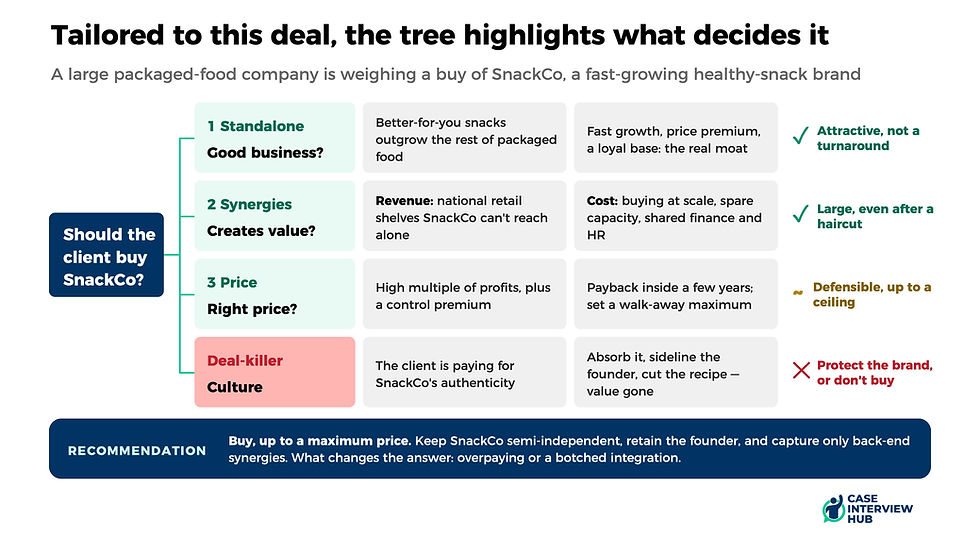
Is SnackCo a good business on its own? The better-for-you snack category is growing well above the rest of packaged food, which is exactly the growth the client lacks. SnackCo grows fast, commands a price premium, and has a genuinely loyal customer base, which is its real moat. On its own, it is an attractive business.
Does combining the two create value? This is where the deal gets interesting. The revenue synergy is large and specific: the client can put SnackCo onto shelves SnackCo could never reach alone, through its existing relationships with national retailers. The cost synergies are real too: buying ingredients and packaging at the client's scale, using spare manufacturing capacity, and merging finance and HR departments. Haircut the revenue synergy, because getting a small brand into big retail is never as smooth as the model says, and subtract the cost of integrating the two. What is left is still a meaningful annual number.
Is the price right? Fast-growing brands do not come cheap. SnackCo will trade at a high multiple of its profits, plus a control premium. Take that premium plus the integration cost, divide by the annual net synergies, and check the payback. If it lands inside a few years, the price is defensible. Set a maximum above which the client should walk.
The risk that would actually kill this deal. It is not the maths, it is the culture. The client is buying SnackCo because it is authentic, nimble, and trusted. If it absorbs the brand into its corporate machine, kills the founder's autonomy, and value-engineers the recipe, it destroys the very thing it paid a premium for. The recommendation has to protect that: keep SnackCo semi-independent, retain the founder and key team, and capture only the back-end synergies that customers never see. In an ideal world, customers would never know that SnackCo is owned by the client.
Recommendation. Buy, up to a defined maximum price, because SnackCo gives the client entry into a fast-growing category, the distribution synergy is large and within the client's control, and the payback clears the bar. Keep the brand at arm's length to protect its authenticity, and confirm the synergy estimates before committing. The two things that would change the answer are overpaying and mishandling the integration.
Notice what happened. The same three questions, tailored to this deal, surfaced the distribution synergy and the culture risk, which are the whole case. A generic tree buries both under generic categories and never finds them. And nowhere in the case did we build a valuation model.
Why Most M&A Deals Disappoint
Worth knowing, because interviewers reward candidates who see it coming: most acquisitions fail to create the value promised, and the reasons are almost always the same:
Cultural clashes and the loss of key talent
Integration that is slower and costlier than planned
Customers who churn when service changes
Antitrust review when the combined business gets too big
Simple overpaying
Strong candidates raise these during the analysis, not as an afterthought. Interviewers will positively notice it if a candidates is willing to walk aways from a deal due to a bad price. We often mention that there is no one “right answer” in most cases and this also holds true for M&A cases.
Common Mistakes
Reciting generic buckets. "Market, company, synergies, financials" with no tailoring earns a rejection, not an offer.
Defaulting to buy. Recommending an acquisition without ever weighing build or partner. M&A is the most expensive option, so it needs a lot of justification.
Vague synergies. "There would be synergies" is not analysis. Put a number on them, split cost from revenue, and haircut the revenue side. Rough assumptions are absolutely fine. Assuming 10% cost synergies by merging back office is always defensible.
Forgetting integration costs. Gross synergies look great until you subtract the cost of capturing them. Always net the synergies.
No price guardrail. "Acquire" with no maximum price is only half an answer. Putting a maximum price tag on a target shows the interviewer that you are considering the option to walk away from the deal.
Ignoring integration and culture. In capability and brand deals, the value walks out the door if the key people leave after the deal.
The Bottom Line
At first glance, M&A cases might look like the type of case that only finance experts can solve. Strip away the vocabulary and it is a case focused on structured thinking, business acumen and basic math with three main questions:
Is the target good on its own?
Does buying it create value net of cost and risk?
Is the price right?
You do not need a financial modeling background. You need to quantify the synergies in plain arithmetic, test whether buying beats building or partnering, name a maximum price, and have the discipline to walk away from a bad deal. Learn the three questions, then make them specific to the deal in front of you.
The fastest way to build this is on realistic cases with feedback on where a top candidate would have gone deeper. Our Case Interview Mastery course on Udemy gives you 7 full McKinsey-style cases, including an acquisition due-diligence case, each with a do-it-yourself version, a model solution, and a feedback version where we explain every move. Taught by us, two former McKinsey interviewers.


