Market Entry Case Interviews: The Complete Guide (2026)
"Should our client enter this market?" is one of the cases you are most likely to meet, alongside profitability. It is also the case that looks the most frameworkable and that is exactly the trap.
So here is the direct answer to the usual question. Is there a standard market entry framework? Yes, four buckets that you should know. Will memorising them get you the offer? No. We spent 6+ years each at McKinsey, first as consultants and later as interviewers, and a case squeezed into the standard market entry structure is one of the easiest things to spot from the other side of the table. We have heard the same four buckets a hundred times. What we are actually testing is whether you can tailor them to the specific company, put numbers on them, and say how the client should enter and what could go wrong.
This guide covers the standard skeleton, the method that turns it into a tailored answer, the options for the market entry, and a full worked example.
What a Market Entry Case Actually Asks
Put simple: A market entry case asks whether a company should compete somewhere it does not compete today. The case comes in three flavours, and they change what goes in your structure:
A new geography. Should a US coffee chain enter Germany?
A new product category. Should a streaming service launch video games?
A new customer segment. Should a consumer brand start selling to large enterprises?
One useful thing to know: a "new product" case is really a market entry case wearing a different hat. The market is a product category instead of a country, but the same logic applies.
The Skeleton: Four Areas, Four Quality Gates
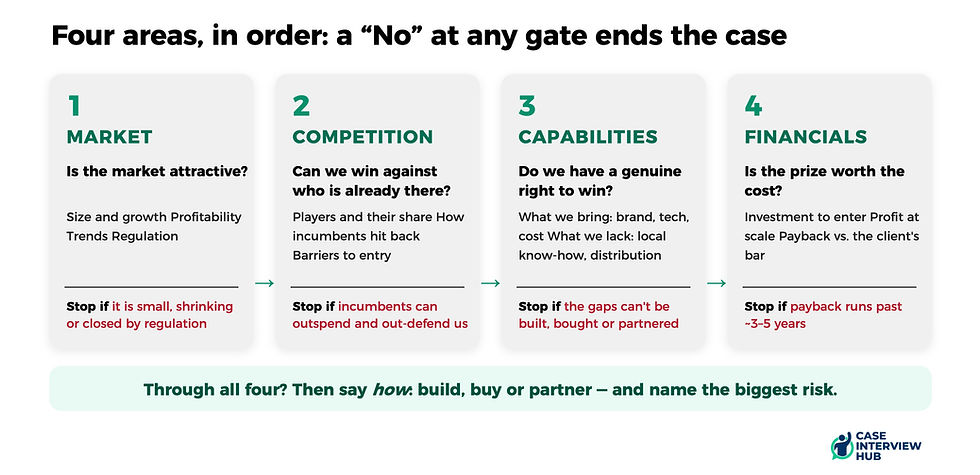
Every market entry framework you will see covers the same four areas: market attractiveness, competition, company capabilities, and financial returns. The trick is that they work best in order, as three gates you pass through:
Is the market attractive? Size, growth, profitability, trends, and regulation. An unattractive market ends the case early.
Can we win against the incumbents? How is the competition on this specific market?
Do we have the capabilities to win? Does the client have the genuine capabilities to win in this market? (i.e., right to win)
Is the prize worth the cost? The investment, the returns, and the payback.
That skeleton is worth knowing cold. But it is the same skeleton for a coffee chain, a bank, and a streaming service. Present it raw and the interviewer learns nothing about you. As we say in our other guides, the four buckets are where you start, not where you win. Tailoring the standardized framework to the case is what sets you as a candidate apart from the rest.
A Simple Method: Tailor, Don't Recite
Here is how to turn the skeleton into an answer.
1. Clarify the objective first. Before you structure anything, ask what success means. Entering for profit, for market share, or for strategic positioning leads to three different analyses. Pin down the timeline and any constraints too, for example whether an acquisition is even on the table.
2. Tailor the four buckets to this company. The top-level buckets can stay the same, but everything underneath must be specific. For a pharma company entering Brazil, the market bucket talks about regulatory approval timelines and public-health pricing, not "market trends." This is the single thing that separates a tailored structure from a memorised one.
3. Work bucket by bucket, with a hypothesis. Do not gather data passively. Say early what you expect ("I think this is attractive because the market is large and growing"), then test it against each new fact. You should not only do this in a candidate-led but also in an interviewer-led case interview as it shows drive.
4. Quantify. Size the market if the interviewer does not hand you the number, then run the payback. Does the market entry pay off in 5, 10, or 20 years? Vague words like "big" and "attractive" are opinions. A number is a finding, and interviewers reward findings.
5. Give a proper recommendation. Answer yes or no, give two or three reasons, then name the entry mode and the biggest risk. A decision with no "how" and no risk is only half an answer.
How to Enter: Build, Buy, or Partner
Most candidates answer whether to enter and forget to say how. The entry mode makes a big difference.. Even when the interviewer only asks "should they enter," spend thirty seconds on the entry mode, because that is what a consultant does for a real client. A client usually knows whether a market is attractive or not but they struggle with operationalization.
There are three broad routes, and a couple of variants inside them:
Build (greenfield). Slowest and most expensive, but full control. Right when protecting technology, brand, or culture matters.
Buy (acquisition). Fastest way to gain market share and capabilities, but you take on price, integration, and culture risk. And you also need a feasible target company to acquire.
Partner (joint venture, licensing, franchising, or exporting). Medium speed and shared risk. Right when local knowledge, regulation, or distribution is the missing piece.
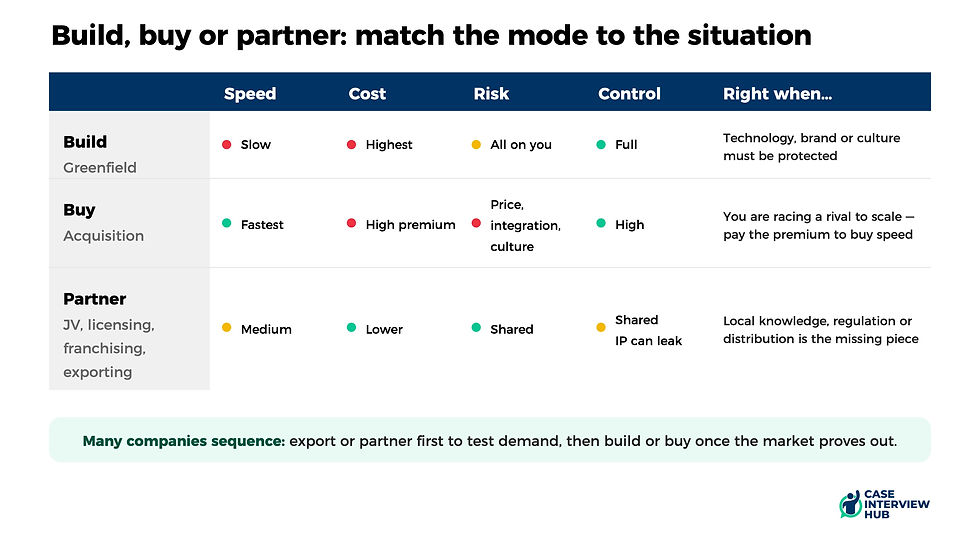
Match the entry mode to the situation. A company with patented technology should avoid a joint venture with a competitor that potentially leaks it. A company racing a rival to scale should pay the acquisition premium to buy speed. And many companies sequence: export or partner first to test demand, then build or buy once the market proves attractive. This tailoring might sound intimidating but keep in mind that no one expects you to be an industry expert. As long as your logic is sound you are fine.
Worked Example: A Streaming Service Entering Germany
Let us demonstrate the information we preach on an exemplary case. StreamCo, a large US streaming service, asks whether it should enter Germany.
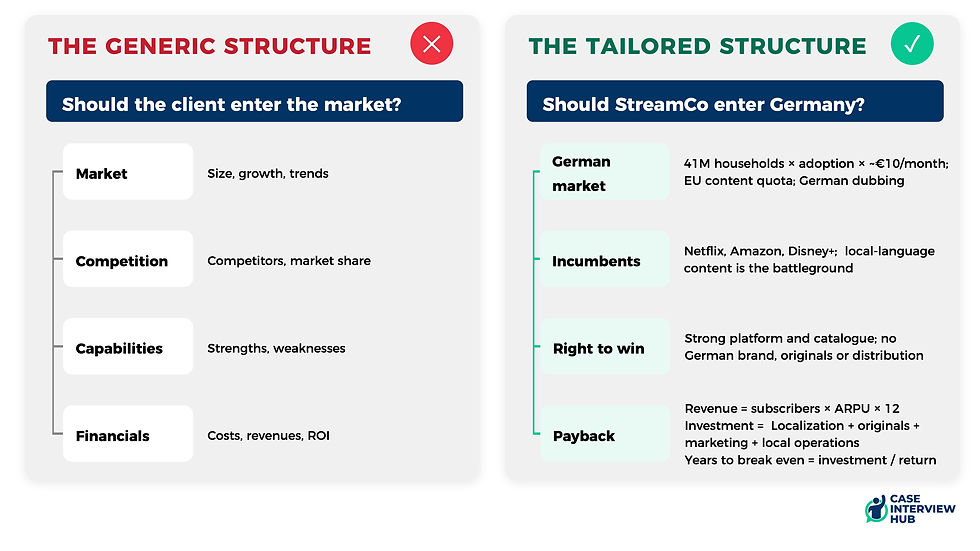
A weak candidate recites the skeleton: market, competition, capabilities, financials, let me check each. This sounds generic and it is generic. Nothing specific about streaming or about Germany. Let’s see how you can tailor the framework to the actual case.
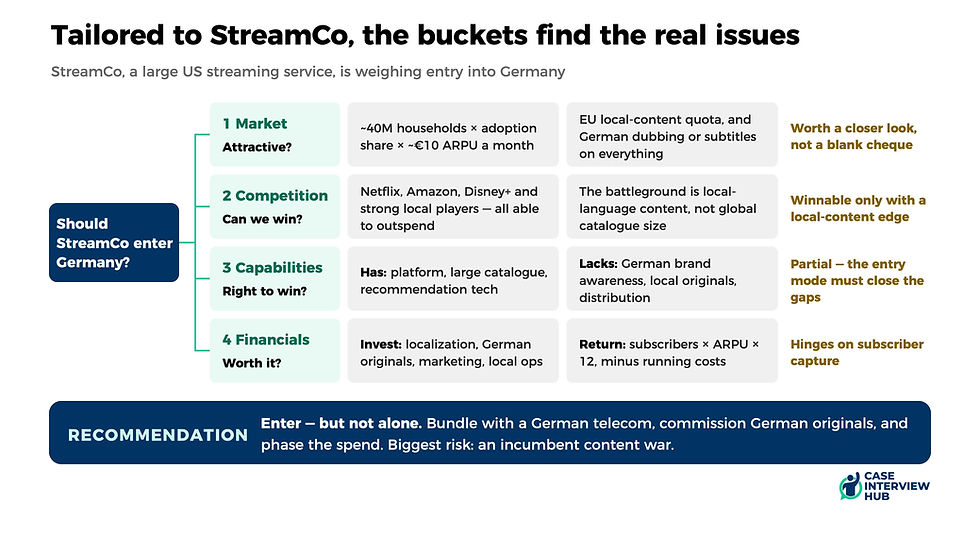
Gate 1: Is the German market attractive? Germany has roughly 80 million inhabitants so let’s assume that is 40 million households. Only a share will pay for yet another subscription on top of the ones they already have, so a sensible estimate multiplies households by an adoption share by an average revenue per user of around 10 euros a month. The market is sizeable but maturing, and two things shape it that a generic tree would miss: EU local-content rules that require a quota of European content on the platform, and the need to dub or subtitle everything into German. Verdict: worth a closer look, but not a blank cheque.
Gate 2: Can StreamCo win? The market already has Netflix, Amazon, and Disney+, plus strong international and local players. Incumbents can outspend a newcomer on content and can defend hard. The real battleground in every country is local-language content, not the size of the global catalogue. Verdict: winnable only with a genuine local-content and distribution edge, not by showing up with the US library.
Gate 3: Does StreamCo have the capabilities? It brings a strong platform, a large catalogue, and recommendation technology. It lacks German brand awareness, local-language originals, and local distribution. Those gaps matter, and they point away from building alone. Verdict: partial, so the entry mode has to close the gaps.
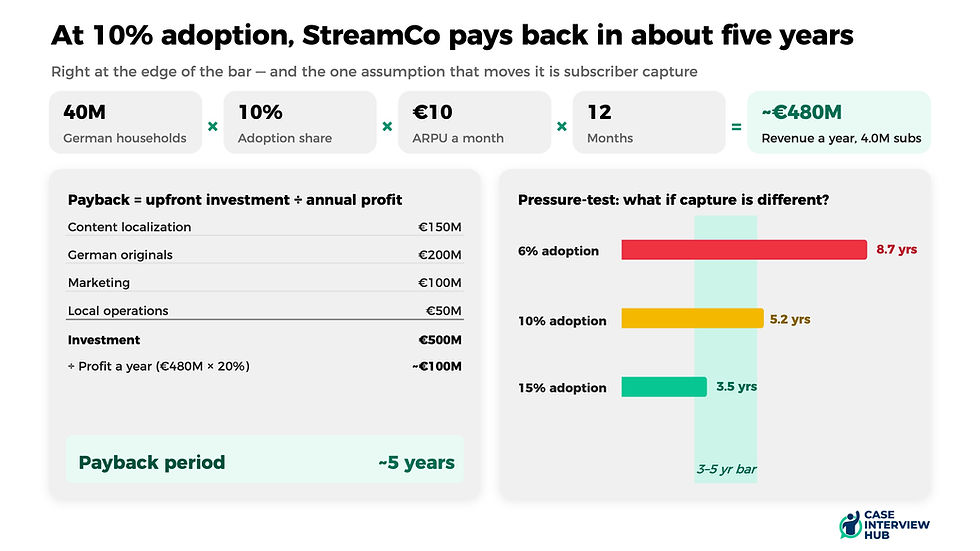
Gate 4: Do the financials work? The investment is content localization, commissioning German originals, marketing, and local operations. The return is subscribers times ARPU (i.e., average return per user) times twelve months, minus running costs. Divide the upfront investment by the annual profit at scale to get a payback period, and pressure-test the one assumption that moves the answer most: how many subscribers StreamCo can realistically capture in the first few years against established rivals.
Recommendation. Enter, but not by building alone. Partner with a German telecom to bundle the service into mobile and broadband plans, which fixes the brand and distribution gaps overnight. Then commission a slate of German-language originals to earn the right to win. Phase it: bundle and test first, invest heavily once the numbers hold. The biggest risk is an incumbent content war that drives up the price of winning subscribers. Next step: pilot a bundling deal and a first local-content slate before committing the full budget.
Notice what we did here. The same four buckets, tailored to streaming and to Germany. The tailoring surfaced local-content quotas, dubbing, telco bundling, and the incumbent content war. A generic tree buries all of that under "Market," "Capabilities," and "Competition," and never finds it.
If you are thinking “Oh my god, how am I supposed to come up with all of this?! I have no clue about the German streaming market”, don’t worry. As mentioned earlier, you don’t have to be an industry expert. As long as you use common sense and tailor it to the case, the interviewer will appreciate and help you along.
The Quant Core: Sizing and Payback
Market entry cases lean on two numbers, and both are skills you can practise on their own.
The first is market sizing. If the interviewer does not give you the market size, you build it from the ground up, exactly as in our market sizing guide. Market sizing is often one of the questions within a market entry case.
The second is payback: the upfront investment divided by the annual profit at scale. A payback under roughly three to five years is generally acceptable in most industries, though the right bar depends on the client. That second calculation is a compact profitability problem, which is why practising these case types together is a smart move.
Market Entry vs the Cases It Is Related To
Market entry rarely shows up in a clean box. It shares DNA with several other case types, and interviewers often morph one into another halfway through, so it helps to recognise which case prototype you are dealing with.
New product cases are market entry cases in disguise. "Should this company launch a new product?" is the same question as "should it enter a market," where the market is a product category rather than a country or geography. The one extra thing to add is cannibalization: some of the new revenue may just be your existing customers switching, which is not new revenue at all. Brand fit and development cost are also priority topics to address in the case.
Growth strategy cases contain market entry. When a client asks how to grow, entering a new market is only one option on the menu, sitting alongside raising prices, launching products, and acquiring competitors. If you get a broad "how do we grow" prompt, treat market entry as one branch of your structure, not the whole thing, and compare it against the other growth levers before you commit.
M&A cases are where the "buy" market entry mode leads. The moment the client decides to enter by acquiring a local player, a market entry case can turn into an M&A problem: is the target a good business on its own, do the two together create value once you subtract integration cost and risk, and is the price fair. Interviewers sometimes pivot a market entry case straight into this territory, so be ready to evaluate a specific target, not just the market.
Market sizing and profitability are the quant tools inside it. Sizing the market is one sub-skill, and the payback gate is a compact profitability calculation. Practicing market sizing and profitability cases really helps in acing market entry cases.
The takeaway is not to memorise a taxonomy. It is to stay flexible, because the strongest candidates notice when a case is drifting from "should we enter" toward "how should we grow" or "should we buy this company," and they react accordingly.
Common Mistakes
Reciting generic buckets. "Market, competition, company, financials" with no case-specific detail underneath earns a rejection, not an offer. It is the most common tell there is.
Skipping the objective. Analysing profit when the client actually wants strategic positioning answers the wrong question.
Ignoring how incumbents respond. Assuming the market leader will sit still while you take share is the most common analytical blind spot. Ask yourself what the most likely reaction of the incumbents will be.
Forgetting cannibalization. In a new-product or new-segment entry, revenue that comes from your own existing customers by substituting your previous product with the new product is not new revenue. It is cannibalization.
Stopping at yes or no. A complete answer names the entry mode, the sequence, and the biggest risk, not just the verdict.
The Bottom Line
Market entry is common and looks easy to frame, which is why so many candidates fail it with a tidy, generic structure. The four buckets take an afternoon to learn. What earns the offer is tailoring them to the company in front of you, quantifying the market and the payback, and recommending like a consultant: not just whether to enter, but how, in what order, and what could go wrong. Learn the skeleton, then make it specific.
The fastest way to build this is on realistic cases with feedback on where a top candidate would have gone deeper. Our Case Interview Mastery course on Udemy gives you 7 full McKinsey-style cases, including market-entry and investment problems, each with a do-it-yourself version, a model solution, and a feedback version where we explain every move. Taught by us, two former McKinsey interviewers.